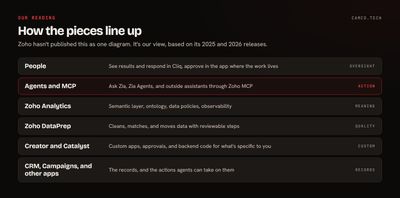
Zoho's apps are lining up into one architecture for AI agents: business apps hold the data and actions, DataPrep cleans the data, Analytics gives it meaning, agents do the work, MCP opens it to outside tools, Creator and Catalyst handle the custom parts, and Cliq keeps people in the loop. Zoho hasn't published that as one diagram, so what follows is our reading, built from its recent releases.
It matters most to Zoho One customers, because many of these pieces are already in the same account and sharing the same identity. We'll separate what Zoho has announced from what we're inferring, and finish with what to do about it.
What has Zoho actually shipped?
The pieces arrived in stages, and the last couple of weeks were busy:
| Date | What Zoho announced | Why it matters here |
|---|---|---|
| July 2025 | Zia LLM, prebuilt agents, Agent Studio, and an MCP server | Its own model, a way to build agents, and a door for outside ones |
| June 2026 | Agentic data foundation guide | Zoho lays out the flow: source systems, DataPrep, Analytics, then Ask Zia, MCP, or API, then agents |
| Oct 28, 2026 | Agentic Zoho Analytics | Semantic layer, ontology, multi-agent Ask Zia, AI Observability |
| Oct 28, 2026 | DataPrep 3.0 | Agents that build pipelines, plus a headless MCP server |
| Oct 29, 2026 | Rebuilt Zoho Campaigns | MCP support, with review set by your workflow and permissions |
Three releases in two days, each following a similar pattern, is the strongest hint of direction. The June post is the closest thing to a published blueprint, and its stated principle is that "each layer has a clear job."
How does each app fit?
Here's how we'd map the seven apps people ask us about:
| App | Its job in the architecture | What it adds for agents |
|---|---|---|
| Zoho CRM | System of record for customers | Records and actions. Its MCP servers are split into Data Insights, Data Operations, Modules, and Workflow & Automation. |
| Zoho Campaigns | Where outbound marketing runs | Prepare, segment, and analyze through agents |
| Zoho DataPrep | Data quality | Normalizing and matching before data reaches anything else |
| Zoho Analytics | Meaning and governance | The semantic layer, ontology, data policies, and observability |
| Zoho Creator | Custom apps and process | Screens and approval workflows for what the standard apps don't cover, plus Integration Flows |
| Catalyst | Custom backend | Code, event handling, and a platform Zoho describes as built for developers and agents working together |
| Zoho Cliq | Where people already are | Channels and bots for alerts and responses, with its own MCP server for messaging |
Sitting across all of them are two ways to run agents. Zia Agents is Zoho's platform for agents that work within your business context, and it has an Agent Store of prebuilt ones. Zoho MCP is the door for other assistants. Its supported services list includes all seven apps above.
Why does the shared context matter?
This is the argument Zoho is really making, and it's a strong one for its existing customers.
Ask anyone who has tried building an agent on top of disconnected systems: the agent is the easy part. The hard part is that "customer" means something different in each tool, the IDs don't match, and permissions live in five places. Zoho's ontology is aimed right at that, with its example of linking a CRM contact to a Books customer and a Desk requester.
Zoho's governance documentation adds the permission side: AI features inherit role-based access, so they can only act on data that the requesting user is allowed to see. Single-vendor context is what a suite can offer most naturally, and you get to benefit from it if your data is in decent shape.
Where do you think Zoho is heading?
The rest is our inference, so weigh it accordingly.
Every app becomes something an agent can use. The pattern across these releases is MCP support plus a statement about permissions. Expect that to keep spreading, since Zoho's list of supported services is already long.
Analytics becomes the shared brain. It's positioned less as a dashboard tool and more as where business meaning lives, including for agents outside Analytics. Its MCP server gives outside clients access to semantic models.
Humans shift from doing to approving. Campaigns, DataPrep, and Agent Studio all describe a person reviewing and confirming, and DataPrep says outright that "Nothing is added until you confirm." We expect more of this, and we think that's the right call.
Cliq becomes a control surface. Zoho hasn't said this, and it's our most speculative point. But a chat tool with bots, an MCP server, and every employee already logged in is a natural place to see what agents did and respond to it.
What should a Zoho One customer do now?
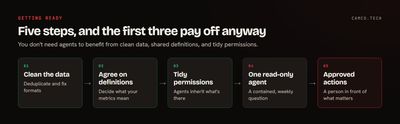
You don't need to adopt all of it, and you shouldn't try. The first three steps here pay off even if you never run an agent:
- Clean the data. Deduplicate your CRM and fix formats. See our DataPrep process.
- Agree on definitions. Decide what your important metrics mean, then record them in the semantic layer.
- Tidy your permissions. Agents inherit them, so anything too loose today gets exposed faster. Check roles, profiles, and who has admin.
- Start with one read-only agent. Choose a contained question your team asks every week, and measure the result.
- Add actions with approvals. Use a clear framework for what runs freely and what waits for a person, and log what happens.
Should you wait until everything's settled? Not for steps 1 to 3. For agents, we'd start small now. These releases are days old and rolling out in stages, so try them on something contained and see what they do with your data before you plan around them.
Here's what this looks like on a real account. On a recent scoreboard build for a sales client on Zoho One, we connected to their Analytics and CRM data through MCP, and worked read-only in Analytics, because the client's owner maintains those query tables. That same client doesn't use Cliq at all, so when a prospect replies to an outbound email, the reply lands as a Note on the CRM record the rep already works from, with no extra email. That's why we'd treat our Cliq point above as a possibility, not a plan. Put the human step wherever your people already are.
What we usually change
When a Zoho One customer asks us about agents, the work usually starts with:
- An inventory of what's in use and where the customer data really lives, since it's often less unified than people assume.
- Linking records across CRM, Books, and Desk so one customer is one customer.
- Cleaning up old automation before agents start triggering it.
- Moving a few high-value metrics into shared definitions.
- Picking the first process, usually one where a person already reviews the output.
Where to start
Most Zoho One accounts have more of this stack available than they're using. If you'd like a straight read on what's worth doing first in yours, that's where our Zoho One work begins. Our generative AI team can take it from there, or you can tell us what you're running.